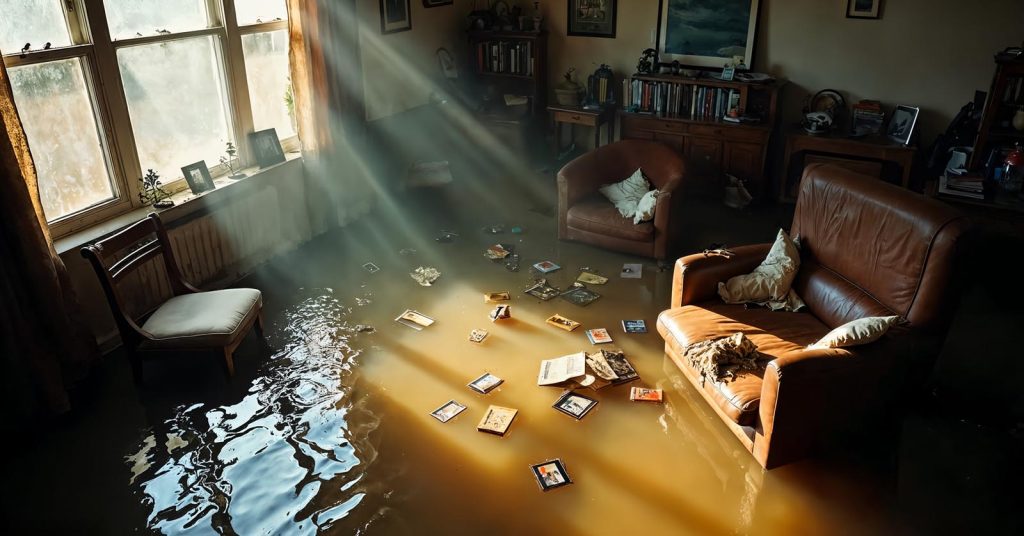
Three inches of water on the same basement floor can lead to three very different insurance outcomes. Burst-pipe damage may point to homeowners coverage. Water rushing in from overloaded streets may meet the flood policy’s definition. A separate endorsement may be needed for sewer backup unless a qualifying flood caused it.
Visible damage alone is not enough to identify which policy pays. Insurance follows the cause of loss, the policy definition, and the contract in force when the event happens. Cause of loss matters most after severe weather, when wind, rain, surface water, sewer systems, and power failures can all contribute to the same damaged room.
Homeowners Insurance vs. Flood Insurance at a Glance
| Issue | Standard homeowners insurance | NFIP flood insurance |
|---|---|---|
| Primary role | Covers specified home, personal-property, liability, and loss-of-use risks under the policy | Covers direct physical loss by or from flood as defined by the Standard Flood Insurance Policy |
| Surface flooding and storm surge | Generally excluded | Can be covered when the event meets the flood definition and damages covered property |
| Burst pipe | Resulting sudden water damage may be covered, subject to the policy and maintenance exclusions | Not a flood merely because water entered the home |
| Sewer or drain backup | Often excluded or limited unless additional water-backup coverage applies | Can be covered when the backup is a direct result of a covered flood |
| Additional living expenses | Can apply when a covered homeowners loss makes the home uninhabitable | Not covered by the NFIP Standard Flood Insurance Policy |
| Basement | Depends on the homeowners cause of loss and policy terms; flood itself remains excluded | Coverage is restricted to specified building systems and limited contents |
| Contents valuation | May be actual cash value or replacement cost depending on the policy and endorsements | NFIP personal property is settled at actual cash value |
Use the table as a starting point rather than a final coverage determination. Limits and features can differ under private flood insurance, while homeowners forms also vary by insurer and state. Your declarations page, exclusions, definitions, and endorsements control your claim.
What Counts as a Flood for NFIP Coverage?
Every large amount of unwanted water is not automatically a “flood” under the National Flood Insurance Program.
Under the NFIP definition, a flood is a general and temporary condition in which two or more acres of normally dry land or two or more properties, at least one of which is the policyholder’s property, are partially or completely inundated by specified causes.
The NFIP definition includes:
- Overflow of inland or tidal waters
- Unusual and rapid accumulation or runoff of surface waters from any source
- Mudflow as defined by the policy
- Certain collapse or subsidence of land along a lake or similar body of water caused by erosion or undermining from waves or currents
Storm surge, a river overflowing its banks, or fast surface runoff spreading across multiple properties can therefore fit the flood definition. Plumbing leaks confined to one house do not become NFIP floods simply because several rooms are underwater.
When Homeowners Insurance Can Cover Water Damage
Standard homeowners insurance excludes flood, but “water damage” is much broader than flood.
State insurance regulators commonly distinguish sudden water losses inside the home from outside surface flooding. Depending on the form and facts, a homeowners claim may involve:
- A burst or suddenly broken plumbing pipe
- An appliance or plumbing system that suddenly releases water
- Rain entering through an opening created by covered wind damage
- Water damage that results from another covered event
Resulting property damage may be covered even when the policy does not pay to repair the worn-out pipe, failed appliance component or maintenance problem that caused the release.
Long-term leakage, seepage, deterioration, mold that could have been prevented, and other maintenance-related conditions can be excluded or limited. Source and timing matter just as much as the amount of water damage.
For the broader property and liability framework, review how homeowners insurance works. A flood claim is not simply another Coverage A or Coverage C claim under that policy because flood is normally outside the standard homeowners contract.
What NFIP Building and Contents Coverage Pays For
For homeowners, the NFIP separates the structure from the belongings inside it.
Building Coverage
Building coverage under the NFIP can insure direct physical flood damage to covered parts of the structure, including items such as:
- The insured building and foundation
- Electrical and plumbing systems
- Central air-conditioning equipment, furnaces, and water heaters
- Refrigerators, cooking stoves, and certain built-in appliances
- Permanently installed cabinets, paneling, and bookcases
- Foundation walls and staircases
- Certain detached garages, subject to policy rules
Under the NFIP regular program, building coverage is available up to $250,000 for a single-family home. The amount you buy still limits the claim, and the policy will not pay more than covered damage measured under its loss-settlement provisions.
Contents Coverage
Contents coverage is purchased separately from building coverage and can insure covered belongings up to $100,000 for a residential policy. Examples include clothing, furniture, electronics, curtains, washers and dryers, certain portable appliances, and some valuable items subject to special limits.
Personal property under an NFIP policy is settled at actual cash value, which reflects depreciation. Qualifying single-family principal residences can receive replacement-cost loss settlement for eligible building damage when NFIP policy requirements are satisfied, including the applicable insurance-to-value requirements.
Separate deductibles generally apply to NFIP building and contents coverage. Homeowners who insure only the building should not assume furniture and other belongings are automatically included.
The NFIP Gaps That Surprise Homeowners Most
A flood policy can cover a catastrophic peril that homeowners insurance excludes and still leave significant expenses outside the claim.
No Additional Living Expenses
Temporary housing and additional living expenses are not covered by the NFIP Standard Flood Insurance Policy while the home is repaired. Hotel bills, extra meal costs, storage, and other displacement expenses therefore do not become NFIP benefits simply because the insured building is uninhabitable after a flood.
Homeowners Loss of Use coverage can pay qualifying additional living expenses after a peril covered by the homeowners policy, but it does not convert an excluded flood into a covered homeowners loss.
Some private flood policies can include additional living expense coverage. Whether yours does depends on the specific contract.
Basement Coverage Is Restricted
NFIP coverage below ground level is much narrower than coverage in ordinary above-grade living space.
NFIP basement coverage can still apply to certain essential building systems and specified appliances, depending on the coverage purchased. Examples include furnaces, water heaters, electrical equipment, central air-conditioning equipment, sump pumps, washers, dryers, and freezers when the applicable policy requirements are met.
Finished walls, many floor and wall finishes, furniture, televisions, and most other personal property kept in a basement are not covered under the NFIP’s basement rules.
Sewer Backup, Sump Overflow and Flood Are Different Triggers
Basement water entering through a floor drain can be one of the hardest losses to classify.
Homeowners policies may exclude sewer or drain backup unless you purchased an endorsement. If this risk matters for your home, check the exact water-backup endorsement, including its dollar limit, deductible, sump language, and exclusions.
Flood coverage under the NFIP uses a different trigger. Sewer-backup damage can be covered when the backup is a direct result of a qualifying flood. Clogs and sewer problems that are not directly caused by flooding do not become covered merely because an NFIP policy exists.
Consider four scenarios:
| Scenario | Coverage to investigate first |
|---|---|
| A supply pipe suddenly bursts inside the house | Homeowners insurance |
| Storm surge or rapid surface runoff enters the house | Flood insurance |
| A sewer backs up because of a blockage unrelated to a flood | Homeowners water-backup endorsement, if purchased |
| A sewer backs up directly because a qualifying flood overwhelms the system | Flood insurance may apply under the flood-policy terms |
Mixed-cause events can require more than one claim analysis. For example, wind may damage a roof while storm surge enters at ground level during the same hurricane. The homeowners and flood insurers can evaluate different portions of the damage under different contracts.
NFIP vs. Private Flood Insurance
Coverage is also available from private flood insurers, and some markets allow flood protection through an endorsement to another property policy.
Broader terms are not guaranteed simply because a flood policy is private. Terms can differ materially. Private flood policies may offer features such as the following, depending on the insurer and state:
- Building or contents limits different from NFIP limits
- Additional living expense coverage
- Different treatment of personal-property valuation
- Broader or different definitions of covered water intrusion
- Different basement provisions
- Different deductibles or waiting periods
Florida, for example, recognizes several types of private flood products with different required features, including policies that can add additional living expenses or replacement-cost treatment for qualifying contents. Florida’s state-specific structure should not be assumed to apply nationwide.
When comparing a private policy with NFIP coverage, put the actual contracts side by side. Compare the flood definition, building limit, contents limit, valuation method, basement treatment, ALE, deductibles, waiting period, exclusions, cancellation rules, and lender acceptance.
When a Mortgage Can Require Flood Insurance
A lender’s flood-insurance requirement does not depend simply on whether the homeowner personally believes the property is likely to flood.
Federal flood-insurance rules generally require coverage for the term of a designated loan when a federally regulated lending institution makes, increases, extends, or renews a loan secured by a building or qualifying mobile home located in a Special Flood Hazard Area in a community where NFIP insurance is available, subject to statutory and regulatory exceptions.
Loan contracts can also impose flood-insurance requirements beyond the federal mandatory-purchase rule as part of their own risk management and loan contracts.
If a lender says flood insurance is required, verify:
- Which insured building triggered the determination
- The FEMA flood-zone determination
- The minimum amount of coverage the lender requires
- Whether an NFIP policy, qualifying private policy, or either is acceptable
- Whether escrow requirements apply to the loan
Federally regulated lenders must accept private flood insurance that meets the applicable statutory definition and mandatory-purchase requirements. Private flood policies can still require lender review.
Buy Coverage Before the Flood Is on the Forecast
NFIP coverage generally begins 30 days after purchase, subject to specific exceptions. Those exceptions include certain policies purchased in connection with making, increasing, extending, or renewing a mortgage; changes made at policy renewal; qualifying newly designated high-risk flood zones; and certain post-wildfire situations.
Private flood policies can use different waiting periods. In catastrophe-prone markets, insurers may also restrict new business or policy changes when a storm is already approaching, subject to state rules and company practices.
Waiting periods and underwriting restrictions make flood insurance difficult to use as an emergency reaction. Flood coverage belongs in an annual insurance review, a home purchase, or another point well before a known storm threat.
Report an NFIP loss promptly and document damaged property before disposal when it is safe to do so. A 60-day Proof of Loss deadline applies under current Standard Flood Insurance Policy forms unless the requirement is waived or extended.
A Better Way to Audit Your Water-Damage Coverage
Instead of asking whether you have “water coverage,” map the ways water could realistically enter your property.
- Start outside. Consider rivers, coastal surge, drainage, surface runoff, nearby slopes, and FEMA flood information.
- Inspect the homeowners exclusions. Identify how the policy treats flood, groundwater, repeated seepage, sewer backup, sump overflow, and mold.
- Check internal-water protection. Understand coverage for sudden plumbing and appliance losses and the maintenance obligations attached to them.
- Review flood building and contents separately. Do not assume one automatically includes the other.
- Look below grade. Compare the value of a finished basement and stored belongings with NFIP basement restrictions.
- Decide whether displacement is a financial risk. NFIP does not provide ALE, so private flood features or your own emergency resources may matter.
- Confirm lender requirements. A mortgage requirement and your personal risk-management decision are related but not identical questions.
- Record waiting periods. Know when a new or increased policy actually becomes effective.
Water losses are easier to insure before they are reduced to a single word such as “flood.” Separate the sources first. Then make sure each important source has a policy, endorsement, or financial plan that actually responds to it.
Frequently Asked Questions (FAQs)
Does homeowners insurance cover flooding from heavy rain?
Standard homeowners insurance generally does not cover surface water that accumulates or runs into the home as floodwater. However, rain entering through an opening created by a covered peril such as wind can be treated differently. Cause and policy wording matter.
What are the NFIP coverage limits for a single-family home?
In the NFIP’s regular program, a residential policy can provide up to $250,000 of building coverage and up to $100,000 of contents coverage. Building and contents are separate coverages with separate deductibles.
Does NFIP flood insurance cover hotel costs?
No. The NFIP Standard Flood Insurance Policy does not cover additional living expenses or temporary housing while the insured building is repaired.
Does flood insurance cover a finished basement?
NFIP basement coverage is restricted. Certain essential building systems and specified appliances can be covered, but finished walls, many finishes, furniture, televisions, and most personal property stored below grade are not covered under the basement rules.
Does flood insurance cover sewer backup?
A sewer or drain backup can fall under NFIP coverage when the backup is directly caused by a covered flood. Clogs and other non-flood problems do not become covered NFIP losses merely because you have a flood policy. Homeowners water-backup endorsements may address a different set of backup events.
How long is the NFIP waiting period?
Most NFIP policies have a 30-day waiting period, with specific exceptions. Private flood insurance can use different effective-date rules, so check the policy before relying on a new purchase.
Do I need flood insurance if I am outside a high-risk FEMA flood zone?
Federal mandatory-purchase rules may not require it, but flood risk is not limited to Special Flood Hazard Areas. Consider the property’s actual drainage, rainfall, river, coastal, and surface-water exposure rather than treating a map boundary as a guarantee that flooding cannot occur.
Sources
- National Flood Insurance Program: What Is a Flood?
- National Flood Insurance Program: Buy a Flood Insurance Policy
- Federal Emergency Management Agency: Standard Flood Insurance Policy Commentary, 2025
- Federal Emergency Management Agency: NFIP Claims Manual, 2025
- National Association of Insurance Commissioners: Flood Insurance
- California Department of Insurance: Residential Property Claims Guide — Water Damage
- Federal Deposit Insurance Corporation: Flood Disaster Protection Act — Lending Requirements
- Florida Department of Financial Services: Flood Insurance Overview and Private Flood Policies