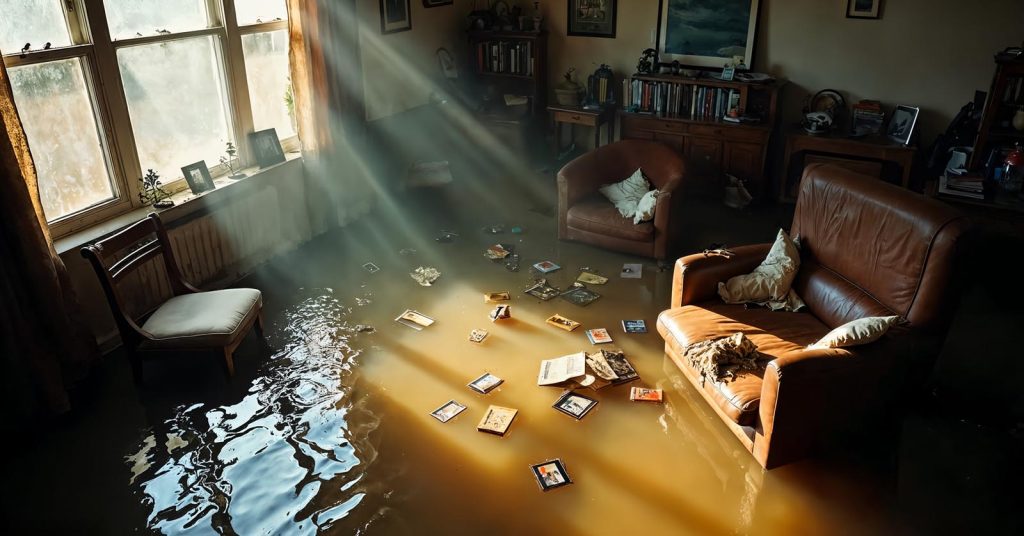
A home can be rebuilt while the contents inside it are still badly underinsured. Furniture, clothing, computers, kitchen equipment, tools, sports gear and dozens of smaller purchases can add up to a much larger replacement bill than a homeowner expects.
Coverage C is designed for that part of the loss, but its declarations-page number does not tell the full story. Identical $100,000 personal-property limits can produce very different protection depending on policy form, valuation method, special limits and where the property is located when the loss occurs.
Review personal property insurance item by item and rule by rule: what you own, what can damage it, how the insurer values it and whether a smaller limit applies before the main Coverage C limit is reached.
Key Takeaways
- Coverage C protects belongings, not the building: Furniture, clothing, electronics and many other household possessions generally fall under the personal-property section of a homeowners policy.
- The policy form affects which losses are covered: HO-3 personal property is generally covered for listed perils, while HO-5 typically provides broader open-peril protection subject to exclusions.
- A large overall limit can still hide gaps: Jewelry, art, antiques, firearms, computers and other valuables can be subject to lower special limits.
- ACV and replacement cost can produce very different claim payments: Actual cash value reflects depreciation; replacement-cost coverage is designed to replace covered property without the same depreciation deduction when policy conditions are satisfied.
- Automatic percentages are only a starting point: Test the Coverage C limit against a home inventory rather than assuming a percentage tied to dwelling coverage matches what you own.
- Property away from home needs a policy-specific check: Coverage may extend off premises, but limits and conditions can differ from losses at the residence.
- Documentation matters before the loss: Photos, receipts, serial numbers and appraisals can make both coverage planning and claim preparation much easier.
What Is Personal Property Coverage?
Personal property coverage is the part of homeowners insurance that protects covered movable belongings owned or used by insured household members, subject to the definitions and terms of the policy. On many standard homeowners forms it appears as Coverage C — Personal Property.
It is different from the parts of the policy that insure the building itself. Coverage A generally applies to the dwelling, while Coverage C focuses on the contents you would ordinarily take with you if you moved.
Examples can include:
- Furniture
- Clothing and shoes
- Televisions and many other electronics
- Kitchenware
- Books
- Tools
- Sports and hobby equipment
- Freestanding household appliances
- Decor and ordinary household goods
Policy definitions can make the category broader or narrower than everyday language suggests. Built-in fixtures generally belong with the building rather than Coverage C, while certain property can be excluded or subject to special treatment.
Within the wider Coverages A through F framework, personal property sits beside dwelling, loss-of-use and liability protection.
What Events Does Coverage C Pay For?
Personal property is covered only when the cause of loss fits the policy.
This is especially important on an HO-3 policy. The dwelling is generally covered on an open-peril basis subject to exclusions, while personal property is typically covered only when the loss results from a peril specifically listed in the policy.
Depending on the form, listed causes can include events such as:
- Fire or smoke
- Lightning
- Windstorm or hail
- Theft
- Vandalism
- Explosion
- Certain sudden water losses
- Other causes specifically named in the contract
An HO-5 generally provides broader treatment for personal property by covering it against causes of loss except those the policy excludes. That can matter when an item is damaged in a way that does not fit one of the named perils in an HO-3.
Form labels are useful shorthand, but endorsements can change the base contract. Declarations, the policy form and attached endorsements together determine what you actually bought.
How Much Personal Property Coverage Do You Need?
Insurers commonly derive the personal-property limit from the dwelling amount, but that automatic number should not substitute for estimating what your household owns.
Compare the actual personal-property limit on each quote rather than assuming every insurer uses the same amount. Base-policy contents limits may be tied to dwelling coverage, but the percentage and available options can vary by policy.
The better test is simple:
If a covered total loss destroyed nearly everything you own, how much would it cost to replace the eligible belongings at today’s prices?
Include the ordinary items that are easy to overlook:
- Everyday clothing
- Bedding and towels
- Dishes, cookware and small appliances
- Furniture in every room
- Electronics and accessories
- Tools and lawn equipment
- Holiday decorations
- Sports equipment
- Books, toys and hobby supplies
- Items stored in closets, basements, attics and garages
Sizing every section of the policy more broadly is covered in how much homeowners insurance you need. For Coverage C specifically, the inventory and sublimits matter more than a generic percentage.
Actual Cash Value vs. Replacement Cost for Belongings
Two policies can have the same Coverage C limit and still pay very different amounts after the same loss.
Actual cash value (ACV) generally reflects the cost to repair or replace covered property after accounting for age, wear and depreciation. An older sofa, television or appliance can therefore produce a claim value well below the cost of buying a comparable new replacement.
Replacement cost value (RCV) is designed to pay the cost to repair or replace covered property with property of like kind and quality without deducting depreciation in the same way, subject to policy limits and conditions.
| Feature | Actual cash value | Replacement cost |
|---|---|---|
| Depreciation | Generally deducted | Not deducted from the final qualifying replacement-cost amount |
| Older belongings | Can create a substantial replacement gap | Designed to provide more toward a comparable new replacement |
| Claim payment | Generally based on the depreciated covered loss | May initially be paid at ACV, with additional qualifying payment after replacement |
| Policy cost | May be lower for comparable coverage | Can cost more because potential claim payments are higher |
Check personal-property valuation separately. Dwelling replacement cost does not automatically give contents the same valuation treatment.
Also watch the claim-payment sequence. Some replacement-cost claims are paid in stages: the insurer may initially pay an ACV amount and release recoverable depreciation after the insured repairs or replaces the property and satisfies the policy’s documentation and timing requirements.
For the mechanics of depreciation and staged payments, see replacement cost vs. actual cash value.
Special Limits Can Matter More Than the Coverage C Total
The main personal-property limit is not necessarily the maximum available for every possession.
Homeowners policies commonly contain special limits, also called sublimits, for certain categories of property. Valuable items such as jewelry, art, antiques, computers and firearms deserve a separate limit check, as do cash, securities, silverware, watercraft and business property.
Some special limits apply to a category regardless of the cause of loss. Others apply only to a particular cause, such as theft. Exact dollar amounts vary by policy and insurer, so copying a number from a generic online chart can be misleading.
When an item is worth substantially more than the applicable sublimit, options can include increasing the category limit or adding scheduled personal property coverage. Insurers may request receipts, photographs, descriptions or an appraisal.
Available endorsements can modify the base policy by scheduling valuable property or adding replacement-cost treatment for personal belongings.
Does Personal Property Coverage Follow Your Belongings Away From Home?
Coverage C is not always confined to items physically inside the house.
Homeowners policies can provide protection for personal property away from the residence, but the amount and circumstances may be restricted. Ask whether property stored away from home is covered and whether a child’s belongings at college remain insured; both can depend on the policy terms.
Situations worth checking include:
- A laptop or luggage while traveling
- A bicycle away from the residence
- Belongings kept in a storage unit
- Property at a second residence
- A student’s belongings at college
- Personal property temporarily moved during repairs
Do not assume an off-premises loss has the same dollar limit, deductible or conditions as a loss at the insured residence. Some forms impose a separate off-premises limit or special rules for property regularly kept elsewhere.
Business use can create another complication. Property used for a home business can be subject to lower limits or require additional business coverage even when the physical item would otherwise look like ordinary personal property.
What Personal Property Coverage Does Not Cover
Coverage C does not turn every damaged possession into an insured claim.
Losses can fail for several different reasons:
- The cause of loss is not covered under the personal-property section
- The policy specifically excludes the cause
- The property itself is excluded or defined elsewhere
- A special limit caps the amount available
- The damage is ordinary deterioration, wear and tear or another maintenance-related problem rather than a covered sudden loss
- The claim falls below the applicable deductible
Two major catastrophe gaps deserve particular attention. Standard homeowners insurance generally excludes flood, and earthquake damage is also generally excluded unless separate coverage or an endorsement applies.
Those exclusions can affect both the building and its contents. Buying enough Coverage C does not create flood or earthquake protection if the cause of loss remains excluded.
For the broader exclusion list, review what homeowners insurance does not cover.
How a Personal Property Claim Is Calculated
A Coverage C claim usually involves several separate questions rather than one multiplication of the loss by the policy limit.
- Was the property insured? The item must fit the policy’s covered-property provisions.
- Was the cause of loss covered? A named-peril policy requires the event to fit a listed peril unless another provision changes the result.
- Does a special limit apply? Valuable or unusual property may have a lower cap than the main Coverage C limit.
- How is the item valued? ACV and replacement-cost terms can produce different amounts.
- What deductible applies? The covered loss can be reduced by the applicable property deductible.
- Have replacement-cost conditions been met? Additional amounts may depend on actual replacement, proof of cost and deadlines.
After a significant loss, create or update the itemized claim list carefully rather than grouping everything into vague categories. Claim documentation may include purchase dates, brands, model numbers, receipts, photos and replacement estimates.
A Home Inventory Is the Best Coverage-Cross-Check
A home inventory serves two purposes: estimating how much personal-property coverage you need and creating a record for a future claim.
Document belongings by room or category and save information such as:
- Item descriptions
- Brand names
- Model and serial numbers
- Approximate purchase dates
- Purchase prices where available
- Receipts
- Photos or video
- Appraisals for valuable property
Do not store the only copy of the inventory in the home it documents. Keep an accessible digital backup or another secure copy that would survive a fire or other major loss.
Update the inventory when you make significant purchases, receive valuable gifts or build a collection. Inventory values can change, so a limit that matched your belongings three years ago may not match them today.
NAIC also offers a Home Inventory app that allows consumers to organize possessions and photos by room or category.
How to Audit Your Personal Property Coverage Before Renewal
A useful annual review can be done without trying to price every sock and spoon precisely.
- Find Coverage C on the declarations page. Record the actual dollar limit.
- Identify the policy form. Check whether personal property is covered on a named-peril or broader open-peril basis.
- Check ACV vs. replacement cost. Do not assume dwelling valuation carries over to contents.
- Update the home inventory. Focus especially on rooms or categories that changed materially.
- List high-value items separately. Compare each one with the special-limits section.
- Review off-premises situations. Storage units, college, travel and property at another residence may need additional questions.
- Separate personal and business property. Ask how equipment used for a business is treated.
- Check the deductible. Know what you would absorb before the policy pays.
- Read endorsements and renewal changes. An endorsement can expand, restrict or change valuation and limits.
Results should answer more than “I have $100,000 of contents coverage.” You should know which belongings fall under Coverage C, which events are insured, how property is valued, where lower limits apply and what you would have to document after a claim.
That is what makes personal-property coverage useful in a real loss: not a large number on the declarations page, but a limit and set of terms that match the property you actually own.
Frequently Asked Questions (FAQs)
Is personal property coverage the same as Coverage C?
On many standard homeowners policies, yes. Coverage C is the section that insures covered personal belongings, subject to the policy’s definitions, limits, covered perils, exclusions and endorsements.
Does homeowners insurance cover all of my belongings?
No. Most ordinary household possessions can fall under personal-property coverage, but some property is excluded, some categories have special limits, and a claim still requires a covered cause of loss.
Is personal property covered at replacement cost automatically?
Not always. Check contents valuation separately. Personal property may be settled at actual cash value unless replacement-cost coverage is included or added by endorsement.
Does Coverage C cover theft away from home?
Some homeowners policies extend personal-property protection away from the residence, but limits and conditions can differ. Review the off-premises provisions instead of assuming the full Coverage C limit follows every item everywhere.
Why does my policy show more personal-property coverage than I think I need?
Your limit may have been generated as a percentage of dwelling coverage. Use a home inventory to test whether that amount is appropriate rather than lowering it solely because the automatic percentage appears high.
Will a high Coverage C limit fully cover expensive jewelry or art?
Protection is not guaranteed. Valuable property can be subject to much lower special limits. Scheduling an item or increasing the applicable limit may be necessary to insure it more fully.
Does personal property coverage have a deductible?
Usually a property deductible applies to covered personal-property claims, but the exact deductible and any exceptions depend on the policy and endorsements. Scheduled items can have different deductible treatment.
What is the best way to prove what I owned after a fire?
A detailed home inventory with photos or video, receipts, serial numbers, purchase information and appraisals can make the claim much easier to document. Keep a backup somewhere that would survive the same loss.
Sources
- National Association of Insurance Commissioners: A Shopping Tool for Homeowners Insurance
- National Association of Insurance Commissioners: What’s the Difference Between Actual Cash Value Coverage and Replacement Cost Coverage?, January 2025
- National Association of Insurance Commissioners: Homeowners Insurance, updated October 2025
- National Association of Insurance Commissioners: Home Inventory
- New York Department of Financial Services: Homeowners Insurance — Basic Coverage and Adding Coverage
- Massachusetts Division of Insurance: Understanding Home Insurance
- Texas Department of Insurance: Home Insurance Guide, updated 2026